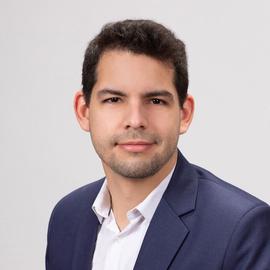
Raul Duarte
Postdoctoral Fellow, Cowles Foundation, Yale University
Yale University (Cowles Foundation for Research in Economics)
Biography
I am a Postdoctoral Fellow at the Cowles Foundation for Research in Economics at Yale University, affiliated with its Political Economy program. In 2027, I will join Florida International University as an Assistant Professor of Economics. My research spans political economy, economic development, comparative politics, and public finance. Among my specific interests are state capacity, corruption, applied machine learning, social networks, electoral integrity, and clientelism. My coauthored work is published in the Review of Economic Studies.
I earned my PhD in Political Economy & Government from Harvard University. Before my doctoral studies, I graduated from Harvard Kennedy School’s MPA/ID program and from Washington University in St. Louis, where I studied Economics and Mathematics. I have also worked as a consultant for the World Bank and the Inter-American Development Bank.
You can download my CV here.
- Political Economy
- Development Economics
- Public Finance
- Comparative Politics
- State Capacity
- Corruption
- Applied Machine Learning
PhD in Political Economy & Government, 2026
Harvard University
Master in Public Administration in International Development (MPA/ID), 2019
Harvard Kennedy School
Bachelor of Arts in Economics, 2015
Washington University in St. Louis
Research
Published
Brokering Votes with Information Spread via Social Networks (Review of Economic Studies, 2025)
with Frederico Finan, Horacio Larreguy, and Laura Schechter
Abstract: Politicians rely on political brokers to buy votes throughout much of the developing world. We investigate how social networks facilitate these vote-buying exchanges. Our conceptual framework suggests brokers should be particularly well-placed within the network to learn about non-copartisans’ reciprocity in order to target transfers effectively. As a result, parties should recruit brokers who are central among non-copartisans. We combine village network data from brokers and citizens with broker reports of vote buying, allowing us to use broker and citizen fixed effects. We show that networks diffuse information about citizens to brokers who leverage it to target transfers. In particular, among those citizens who are not registered to their party, brokers target reciprocal citizens about whom they can learn more through their network, and these citizens are more likely to support the brokers’ party. Moreover, recruited brokers are significantly more central than other citizens among non-copartisans, but not among copartisans. These results highlight the importance of information diffusion through social networks for vote buying, broker recruitment, and ultimately for political outcomes. (PDF)
Working Papers
Patronage Hierarchies, Corruption, and Tax Collection (2026)
Abstract: Why are developing country bureaucracies ineffective despite repeated modernization efforts? Patronage (hiring on partisanship rather than merit) is often thought to undermine public sector performance, yet it is difficult to measure and usually studied either among frontline agents or supervisors separately, rather than across hierarchical layers. I emphasize patronage hierarchies, instances where layers of the bureaucracy have patronage hires, and measure how they affect state performance. I study this problem using comprehensive data on around 300,000 shipments inspected by Paraguayan customs and develop a method for identifying patronage hires based on political appointment cycles. My findings suggest that patronage inspectors monitored by a patronage port administrator (patronage pairs) exhibit compounded underperformance. They detect less customs fraud and more often fail to detect fraud subsequently identified by headquarter audits, while also deviating more frequently from prescribed random assignment of inspectors to shipments. Additionally, their fraud detection decreases further when dealing with high shipment volumes at their port, as high workloads can mask lower inspection effort. Finally, patronage pairs make smaller tax adjustments than non-patronage pairs, even among comparable products with similar tax evasion risks. Shipments handled by patronage pairs generate around 11% less tax revenue, undermining state capacity.
Getting a Seat at the Table: Partisan Poll Workers and Electoral Bias (2025)
with Andrés Carrizosa
Abstract: Does poll workers’ partisanship affect electoral outcomes? Many countries use partisan and adversarial vote-counting systems where poll workers are party representatives and mutual control is expected to provide fairness. Yet in countries with established party regimes, parties often have de facto unequal capacities to send representatives to all booths. Exploiting quasi-random assignment of voters to booths in Paraguay’s 2018 general elections, we estimate that partisan poll workers decrease an opposing party’s vote share by up to 1.1 percentage points (pp) and increase theirs by up to 0.7pp. Our analyses also expose differential effects according to the electoral system. In proportional representation races, established parties have more opportunities to increase their support at the expense of smaller parties. In contrast, single-winner plurality races dampen this effect due to the winner-take-all aspect of these races. Our results have practical implications for politicians and policymakers, and theoretical implications for elections in developing democracies.
Coalition Trimming of Purged Elites (2025)
with Jesús Daboin Pacheco and José Morales-Arilla
Abstract: Do leaders court or cut the entourage of sidelined elites during economic crises? We look at the case of Rafael Ramirez, Venezuela’s former Oil Czar, who was purged from Chavismo’s Cabinet in late 2014. We find that Ramirez-affiliated individuals and firms became discretely less likely to receive government appointments and contracts upon his purge. Effects on appointments are greatest for high-spending agencies, and firms affiliated with the military and with Nicolas Maduro gained access to government contracts. Downstream agents seem to share the fortunes of their patrons after coalition-shaping policies induced by worsening economic conditions.
In Preparation
Brokers on the Payroll: The Patronage Consequences of Becoming a Political Broker
Customs Efficiency Around the World
with Yewon Choi, Ana Fernandes, Bob Rijkers, and Niharika Satish
Decentralizing Intergovernmental Grants: Evidence from Indonesia’s Village Fund
with Vincent Tanutama
Improving Customs Auditing Algorithms through Machine Learning
with Ernesto Dal Bó, Frederico Finan, and Laura Schechter
Land Misallocation and Agricultural Productivity
with Chang-Tai Hsieh
Technological Capacity
with Anders Jensen. Chapter in preparation for the Oxford Handbook of State Building and State Capacity, eds. Mark Dincecco and Yuhua Wang. Oxford University Press.
Voting Technology, Political Competition, and Clientelism
Teaching
Teaching Fellow — DPI-410: The Politics of Development
Harvard Kennedy School – Cambridge, MA – Spring 2023
- Taught by Gautam Nair at the Harvard Kennedy School
- Course Website
Teaching Fellow — DEV-101: Economic Development: Theory and Evidence
Harvard Kennedy School – Cambridge, MA – Fall 2022
- Taught by Eliana La Ferrara and Dani Rodrik at the Harvard Kennedy School
- Course Website
Teaching Fellow — ECON 50: Using Big Data to Solve Economic and Social Problems
Harvard University – Cambridge, MA – Spring 2022
- Taught by Raj Chetty and Greg Bruich at Harvard College
- Course Description and Materials
Teaching Fellow — Contemporary Developing Countries: Entrepreneurial Solutions to Intractable Problems
Harvard University – Cambridge, MA – Fall 2021
- Taught by Tarun Khanna, Satchit Balsari, Krzysztof Gajos, Doris Sommer, and Rahul Mehrotra at Harvard College
- Awarded Certificate of Distinction for Excellence in Teaching
- Course Website
Stata/R Tutor — Harvard Economics Department
Harvard University – Cambridge, MA – Fall 2021 and Spring 2022
- Weekly office hours on the Department’s Stata/R support team
- Course Website
Policy
Intelligent taxation and AI: Promises and pitfalls
International Growth Centre (IGC) - January 2026 (with Anders Jensen)
Opinion and Media
Opinion Articles and Blog Posts
- “Aprendiendo de la historia: para acabar con el nepotismo, hay que levantarse” [Learning from history: to end nepotism, we must rise up] (ABC Color, January 2024)
Contact
- raul.duarte 'at' yale.edu
- 30 Hillhouse Avenue, New Haven, CT 06511